
‘It has been the most hyped, yet has been the most underwhelming Ashes for years’: Michael Atherton | Cricket News
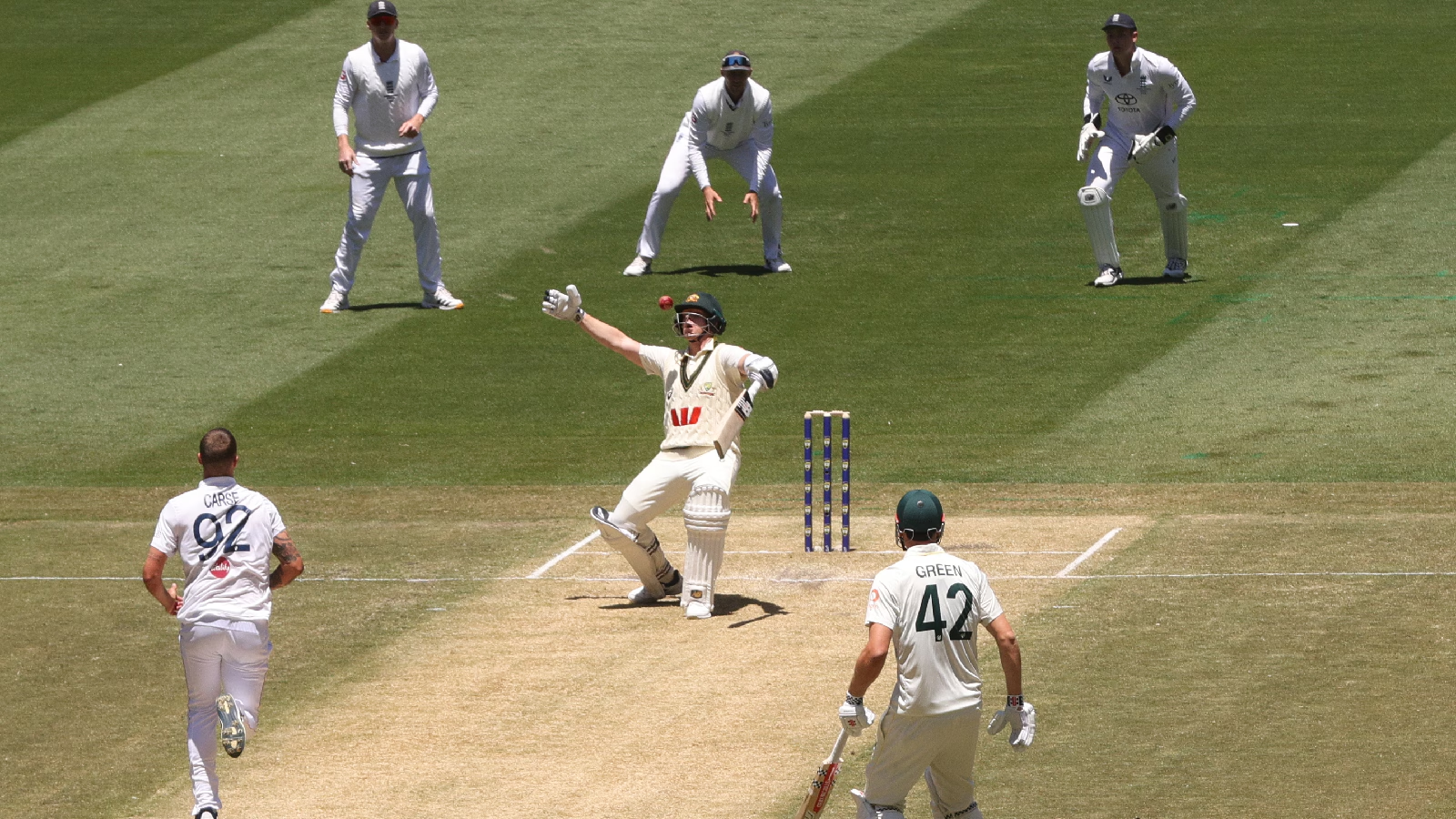
With Australia making sure that England would not win the Ashes in Australia since 2011 with three wins in the first three Tests in the ongoing Ashes series, it means that the Ben Stokes led England side can only end up reducing the deficit to 2-3 in case the side wins the Sydney Test. With Australia winning the Perth Test by eight wickets followed by the wins at Brisbane and Adelaide by eight wickets and 82 runs respectively, England won their only Test of the series so far at Melbourne. The Boxing Day Test became the third shortest Test in Australia with the Perth Test being the second shortest in terms of balls bowled and former England captain Michael Atherton has termed the current Ashes as the ‘most underwhelming Ashes’ for years.
“What will be made of this series in years to come? It has been the most hyped, yet has been the most underwhelming Ashes for years. The matches have been one-sided and uncompetitive and have produced 13 days of haphazard, error-strewn and slapdash cricket. It won’t take much here in Sydney to add a little lustre to it. It has not been a vintage Ashes. There is wry acknowledgement of far more chin-stroking in the local media after the two-dayer in Melbourne than there was in Perth (no prizes for guessing why). Yet, even as Australians take delight in hammering the Poms, there is also a genuine yearning for a proper struggle in the final Test, one that reveals the full variety and glory of the five-day game. Otherwise, why are we all here?,” Atherton wrote in his column for The Times.

Since Brandon Mccullum took over the role of England coach, England have won 25 Tests out of the 44 Test matches with 14 of those wins coming in the first 19 Tests during McCullum’s tenure. England’s four- wicket win was the first time England won a Test in Australia since 2011. England have lost 13 Tests in the last two years as compared to 11 Test wins in the same time. With critics questioning England’s form under McCullum and captain Ben Stokes, the England captain defended McCullum and his team ahead of the Sydney Test. Atherton shared his views about how he sees Australia going through a transition rather than the England side but England took a wrong turn somewhere in the last few months.
“Oddly, given the results, it feels as though Australia’s team is on the cusp of more significant change than England’s. Usman Khawaja announced that this will be his last Test and he will surely be followed by others in the not-too-distant future. On the same day Ben Stokes was in a reflective mood, but less downbeat than he had been before Melbourne, when the tour reached its nadir. He gave his full backing to Brendon McCullum saying that he had no doubt they were the right people to take the team forward in the near future, that he could not imagine moving the team forward with someone else, and that ripping everything up would simply rewind things back to where they were four years ago at the end of the previous Ashes. Given everything we know about the relationship between the two, and Stokes’s loyal character, that was not unsurprising — what else was he going to say? — especially with the series still going. Yet it came with a clear caveat too, and an honest assessment that results and performances have declined in the past year,” added Atherton.
Atherton also advised England to accept the planning and basis of preparation for The Ashes had gone wrong. “Stokes said there was the need to use the time before the next Test — six months away in June — to think about how “to get things going in the right direction again”. Implicit in that is they have taken a wrong turn somewhere. While Stokes said that McCullum’s role to take in white-ball duties has not affected the Test team in any way, that expansion means McCullum will be on the road now until the end of the T20 World Cup in March, making immediate reflection on this tour more difficult. That cannot be a good thing for either set-up, red ball or white ball. There should, at least, be an acceptance that the basics of preparation and planning had gone awry here, and that the pendulum, which always swings back and forth, has to move back towards an environment which embraces pressure, is results-orientated and geared more obviously towards high performance. That recalibration would be much easier to achieve than starting all over again,” Atherton wrote.


